
Hibiscus Tea for High Blood Pressure: Benefits, How to Make, Dosage and Side Effects
Medically reviewed by: Dr. Arun Jharwal, BAMS, MD (Ayurveda)
Last updated: 10 November 2026
Quick answer: Hibiscus tea can modestly lower mild high blood pressure. A 2015 meta-analysis of 5 randomised trials (390 people) found it lowered systolic blood pressure by about 7.6 mmHg and diastolic by about 3.5 mmHg. Its deep red anthocyanins help blood vessels relax, and it acts as a mild natural diuretic. Most of this research used roselle (Hibiscus sabdariffa), the plant sold as “hibiscus tea”, not the common garden gudhal flower.
- Simple recipe: 1 teaspoon dried hibiscus petals (calyces) in 1 cup of hot water, covered for 5–7 minutes. Drink 1–2 cups a day.
- Who it may help: adults with high-normal or mildly high blood pressure, alongside diet, exercise and any prescribed medicine.
- Who should avoid it: pregnant women, people with low blood pressure, and anyone trying to conceive.
- On BP medicine? Keep taking it and check your BP regularly, because the effects can add up. Never stop prescribed medicine on your own.
- Not a cure: hibiscus tea helps a little; salt reduction, exercise and medicines (when needed) do the heavy lifting.
Important: Which Hibiscus Is Used for Blood Pressure?
Two different plants are both called “hibiscus” in India, and they are often confused. The blood pressure trials were done on roselle (Hibiscus sabdariffa), whose dried red calyces are sold as hibiscus tea. The red gudhal flower that grows in most Indian homes is China rose (Hibiscus rosa-sinensis), a different species with only limited animal research for blood pressure.
| Feature | Roselle | Gudhal (China rose) |
|---|---|---|
| Botanical name | Hibiscus sabdariffa L. | Hibiscus rosa-sinensis L. |
| Common Indian names | Lal ambadi, Gongura (leaves), Mesta | Gudhal, Jasvand, Japa, Jaswand |
| Part used for tea | Dried fleshy red calyces around the fruit | Flower petals |
| Taste of tea | Strongly sour, cranberry-like | Mild, slightly astringent |
| Human trials for blood pressure | Yes – several randomised trials and meta-analyses | No good human trials; mainly animal and lab studies |
| Main traditional use in India | Food (gongura chutney), sour drinks | Hair care, heavy periods, worship (Japa in Ayurveda) |
| Pregnancy | Avoid | Avoid – traditionally used to bring on periods; anti-fertility effects in animals |
What this means for you: if you buy packaged “hibiscus tea” or dried hibiscus flowers online, check the label for Hibiscus sabdariffa. Gudhal flower tea is a pleasant traditional drink, but it has not been tested in people with high blood pressure, so do not rely on it for BP control.
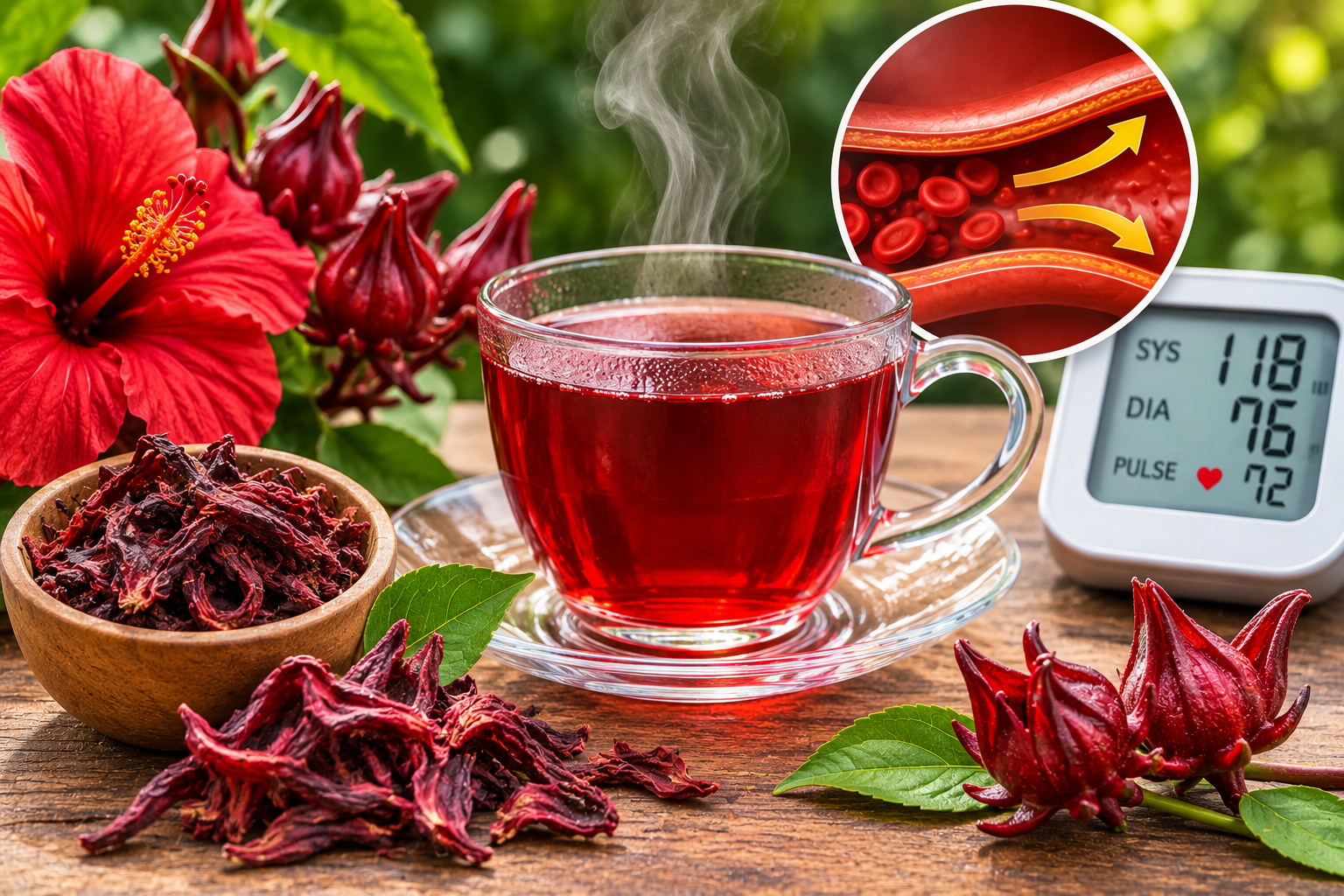
Why Blood Pressure Rises With Age, and How Hibiscus May Help
As we age, our arteries slowly lose their stretch, much like an old rubber band. Stiffer arteries push back harder against each heartbeat, so the heart has to work harder and the systolic (upper) number rises. Extra salt, extra body weight, stress and poor sleep add to the load.
Researchers think hibiscus works in three ways:
- Relaxes blood vessels: its anthocyanins (the compounds that give it a deep red colour, mainly delphinidin-3-sambubioside and cyanidin-3-sambubioside) help the inner lining of blood vessels release nitric oxide, which lets them widen.
- Acts like a mild ACE inhibitor: lab studies show hibiscus compounds partly block angiotensin-converting enzyme (ACE), the same target as common BP medicines such as enalapril and lisinopril, though far more weakly.
- Mild diuretic effect: in trials, hibiscus increased the amount of sodium passed in urine, which helps the body let go of extra salt and water.
These effects are gentle. That is why hibiscus tea suits high-normal or mildly high blood pressure, but cannot replace treatment for moderate or severe hypertension.
Blood pressure categories (for reference)
| Category | Systolic (upper) | Diastolic (lower) |
|---|---|---|
| Normal | Below 120 mmHg | Below 80 mmHg |
| Elevated / high-normal | 120–129 | Below 80 |
| Stage 1 hypertension | 130–139 | 80–89 |
| Stage 2 hypertension | 140 or higher | 90 or higher |
| Emergency – seek care immediately | Above 180 | Above 120 |
Categories follow the 2017 American College of Cardiology / American Heart Association guideline; some Indian guidelines start treatment at 140/90.
What the Research Shows
Hibiscus tea has more human blood pressure research than most herbal drinks, but the studies are small and short, so the evidence is promising rather than final.
| Study | Who took part | What they took | Result |
|---|---|---|---|
| McKay et al., Journal of Nutrition, 2010 | 65 adults aged 30–70 with high-normal or mild high BP | 3 cups (240 ml each) of hibiscus tea daily vs a look-alike placebo drink, 6 weeks | Systolic fell 7.2 mmHg vs 1.3 mmHg with placebo; those with higher starting BP saw a 13.2 mmHg drop |
| Serban et al., Journal of Hypertension, 2015 (meta-analysis) | 5 randomised trials, 390 people | Hibiscus tea or extract | Systolic down 7.58 mmHg, diastolic down 3.53 mmHg compared with control |
| Herrera-Arellano et al., 2004 and 2007 | Adults with mild to moderate hypertension | Standardised hibiscus infusion or extract, 4 weeks | BP fell in a way comparable to captopril and lisinopril, with more sodium passed in urine; study design had weaknesses |
| Haji Faraji and Haji Tarkhani, 1999 | Adults with untreated essential hypertension | Sour tea (hibiscus) for 12 days | BP fell during use and rose again after stopping |
What this means in practice
- A drop of 5–8 mmHg in systolic pressure is meaningful: it is roughly what you get from cutting salt or losing a few kilos.
- The effect lasts only while you keep drinking it; BP rose again when people stopped.
- In the McKay trial, the diastolic (lower) number also fell (3.1 vs 0.5 mmHg), but the difference from placebo was not statistically significant.
- The studies that compared hibiscus with BP medicines were small and had design flaws, so do not swap your medicine for hibiscus tea.
The Ayurvedic View
Classical Ayurvedic texts describe gudhal as Japa (also Japapushpa, Javaa, Odrapushpa, Rudrapushpa), a sacred flower offered to Goddess Kali and Lord Ganesha. Roselle (H. sabdariffa) arrived in India later and is not described in the classical texts, so the Ayurvedic properties below refer to Japa.
Japa (Gudhal) properties
- Rasa (taste): Kashaya (astringent), Tikta (bitter)
- Guna (qualities): Laghu (light), Ruksha (dry)
- Virya (potency): Sheeta (cooling)
- Vipaka (post-digestive effect): Katu (pungent)
- Dosha effect: mainly balances Pitta and Kapha
- Traditional uses: heavy menstrual bleeding (Raktapradara), hair fall and premature greying (Keshya), burning sensation, and as an emmenagogue to bring on delayed periods
How Ayurveda looks at high blood pressure
Ayurveda has no single term for hypertension. Practitioners usually see it as a Vata–Pitta disturbance involving Rakta (blood) and the channels (Srotas), often with Kapha and Ama when there is obesity. Cooling, Pitta-calming drinks such as Japa or roselle tea fit this approach, alongside classical herbs like Arjuna, Sarpagandha (only under a doctor’s supervision), Jatamansi and Brahmi, and lifestyle measures such as Pranayama and reduced salt.
This is a traditional framework; it should complement, not replace, regular BP checks and modern treatment.
Other Benefits of Hibiscus Tea
Blood pressure is the best-studied benefit. The others below have weaker evidence.
| Benefit | What is known | Type of evidence |
|---|---|---|
| Lowers mild high BP | Systolic down about 7 mmHg on average | Randomised trials, meta-analysis |
| Cholesterol and triglycerides | Mixed results; some trials show small falls in LDL and triglycerides, others show no change | Small human trials |
| Antioxidant | Rich in anthocyanins and other polyphenols | Lab and small human studies |
| Blood sugar | Small effects in some studies of people with diabetes | Small human trials, animal studies |
| Liver health | Protective effects against fatty liver | Mainly animal studies, one small human trial |
| Hydration and cooling in summer | A tasty, sugar-free alternative to soft drinks when made without sugar | Practical use |
| Hair (gudhal) | Traditional use of gudhal flowers and leaves in hair oils and packs | Traditional use, lab studies |
How to Make Hibiscus Tea
Hot hibiscus tea (basic recipe)
- Boil 1 cup (240 ml) of water and let it rest for a minute.
- Add 1 teaspoon (about 1.5–2 g) of dried hibiscus calyces or petals, or 1 hibiscus tea bag.
- Cover the cup and steep for 5–7 minutes. Covering keeps the colour and aroma in.
- Strain and drink plain, or with a few drops of lemon or a small piece of ginger.
The tea will be bright ruby red and pleasantly sour.
Cold-brew hibiscus (summer cooler)
Soak 2 teaspoons of dried hibiscus in 2 cups of room-temperature water for 4–6 hours, or overnight in the fridge. Strain and drink chilled with mint leaves. Cold brew tastes smoother and less sour.
BP-friendly add-ons
- Ginger or cinnamon: add warmth and flavour.
- Mint or a few tulsi leaves: add freshness.
- Avoid sugar and salt: sugar adds calories and salt works against BP control. If you need sweetness, use a little honey after the tea has cooled slightly.
Fresh gudhal flower tea (traditional)
Wash 2–3 fresh red gudhal flowers, remove the green base and stamens, and steep the petals in a cup of hot water for 5 minutes. This is a pleasant traditional drink, but remember it has not been tested for blood pressure in humans.
Best time to drink it
- Morning or mid-afternoon, between meals.
- Avoid drinking it late at night, as its mild diuretic effect may make you wake up to urinate.
- If you take BP medicine, keep a gap of 1–2 hours from your medicine and check your BP regularly.
Dosage
| Form | Usual adult amount |
|---|---|
| Dried hibiscus (roselle) tea | 1–2 cups a day, 1 teaspoon per cup (trials used up to 3 cups a day) |
| Hibiscus tea bags | 1–2 bags a day |
| Hibiscus extract capsules | Only on a doctor’s advice |
| Fresh gudhal flower tea | 1 cup a day |
Give it 4–6 weeks of regular use and track your BP at home to see whether it helps you.
Side Effects and Who Should Avoid Hibiscus Tea
Hibiscus tea was well tolerated in clinical trials. The main risks come from its blood-pressure-lowering effect, its effect on pregnancy, and a few drug interactions.
Possible side effects
- Dizziness or light-headedness if BP drops too low, especially when combined with BP medicines
- More frequent urination, because of its mild diuretic effect
- Acidity or tooth sensitivity in some people, because the tea is very sour; rinse your mouth with water afterwards
- Allergic reactions (rare)
Who should avoid it
- Pregnant women: gudhal is traditionally used to bring on periods, and hibiscus extracts showed anti-fertility and anti-implantation effects in animals. Safety in pregnancy has not been established for either species.
- Women trying to conceive and breastfeeding mothers: there is not enough safety data.
- People with low blood pressure or frequent dizziness.
Who should ask a doctor first
- People on BP medicines or diuretics: the effects can add up; check your BP regularly and never stop or change your medicine on your own.
- People on diabetes medicines: hibiscus may lower blood sugar slightly.
- People taking chloroquine or hydroxychloroquine: hibiscus may lower chloroquine levels in the blood.
- People taking paracetamol (acetaminophen) regularly: hibiscus changed how the body handles paracetamol in a small study.
- People with kidney disease or on fluid restrictions.
- People scheduled for surgery: stop about two weeks before, because it can affect blood pressure.
When to see a doctor straight away
If your BP is 180/120 mmHg or higher, or you have chest pain, severe headache, breathlessness, blurred vision or weakness on one side of the body, seek emergency care. No tea can treat this.
Hibiscus Tea vs Green Tea, Lauki Juice and Coconut Water
All four drinks are popular for high blood pressure in India. Here is how they compare.
| Drink | Evidence for lowering BP | Key caution |
|---|---|---|
| Hibiscus (roselle) tea | Several randomised trials; systolic down about 7 mmHg on average | Avoid in pregnancy and low BP; may add to BP medicines |
| Green tea | Meta-analyses show a small drop, around 2 mmHg | Contains caffeine; may affect sleep and iron absorption |
| Lauki (bottle gourd) juice | No good human trials for BP | Never drink lauki juice that tastes bitter – bitter bottle gourd can be toxic and has caused serious poisoning |
| Coconut water | Very limited studies; it provides potassium, which helps balance sodium | High in potassium – people with kidney disease or on certain BP medicines (ACE inhibitors, potassium-sparing diuretics) should limit it |
None of these drinks can replace medicine for diagnosed hypertension, but hibiscus tea has the strongest evidence among them.
Lifestyle Steps That Matter More Than Any Drink
Hibiscus tea works best as one part of a wider plan. These habits have stronger evidence for lowering blood pressure:
- Cut salt to under 5 g (about one teaspoon) a day, as the World Health Organization advises. Watch pickles, papad, namkeen, packaged snacks and restaurant food.
- Eat more potassium-rich foods such as fruits, vegetables, dal and curd, unless your doctor has told you to limit potassium.
- Move for at least 150 minutes a week, for example a 30-minute brisk walk five days a week.
- Keep a healthy weight and waist size; even a few kilos of weight loss lowers BP.
- Limit alcohol and stop smoking.
- Sleep 7–8 hours and manage stress with Pranayama, meditation or yoga.
- Check your BP at home with a validated digital monitor and keep a record to share with your doctor.
Myths vs Facts
| Myth | Fact |
|---|---|
| Hibiscus tea can replace BP medicine. | It lowers systolic BP by about 7 mmHg on average. That helps, but it is not enough for moderate or severe hypertension. Never stop medicine on your own. |
| Any hibiscus flower works the same. | The BP trials used roselle (Hibiscus sabdariffa). Garden gudhal (H. rosa-sinensis) has not been tested in humans for BP. |
| More cups mean a bigger drop. | Trials used up to 3 cups a day. Drinking much more can cause dizziness, frequent urination and acidity without proven extra benefit. |
| Natural means safe in pregnancy. | Hibiscus is traditionally used to bring on periods and showed anti-fertility effects in animals. Avoid it in pregnancy. |
| Once BP is controlled, you can stop the tea. | The effect fades after stopping; BP rose again within days in one study. |
| Adding sugar or salt does not matter. | Salt works directly against BP control, and sugar adds calories. Drink it plain or with a little lemon or ginger. |
Scientific Research
The human studies below are small and short, so larger and longer trials are still needed.
- Hibiscus tea in high-normal and mild hypertension (randomised, placebo-controlled): 3 cups a day for 6 weeks lowered systolic BP by 7.2 mmHg vs 1.3 mmHg with placebo in 65 adults. McKay DL, Chen CY, Saltzman E, Blumberg JB. The Journal of Nutrition, 2010; 140(2): 298–303. Summary (USDA)
- Meta-analysis: 5 randomised trials, 390 participants; systolic BP fell by 7.58 mmHg and diastolic by 3.53 mmHg. Serban C, Sahebkar A, Ursoniu S, Andrica F, Banach M. Journal of Hypertension, 2015; 33(6): 1119–1127. PubMed
- Compared with captopril: a standardised hibiscus extract lowered BP in mild to moderate hypertension. Herrera-Arellano A et al. Phytomedicine, 2004.
- Compared with lisinopril: a hibiscus extract lowered BP and increased sodium excretion in urine. Herrera-Arellano A et al. Planta Medica, 2007.
- Untreated essential hypertension: sour tea lowered BP over 12 days, and BP rose again after stopping. Haji Faraji M, Haji Tarkhani AH. Journal of Ethnopharmacology, 1999.
- Safety, dosing and drug interactions (monograph): lists interactions with chloroquine, paracetamol and BP medicines, and advises avoiding hibiscus in pregnancy and breastfeeding. Drugs.com – Hibiscus
- Gudhal and fertility (animal study): among seven Indian plants screened, Hibiscus rosa-sinensis flower extract showed significant anti-fertility activity in female rats. Kholkute SD, Mudgal V, Deshpande PJ. Planta Medica, 1976; 29(2): 151–155.
Frequently Asked Questions (FAQs)
Does hibiscus tea really lower blood pressure?
Yes, modestly. Randomised trials show it lowers systolic BP by about 7 mmHg on average in people with high-normal or mildly high BP. It is not strong enough to replace medicine for moderate or severe hypertension.
How fast does hibiscus tea lower blood pressure?
In trials, the effect built up over 2–6 weeks of daily use. A single cup is not a quick fix for a BP spike.
How many cups of hibiscus tea should I drink for high BP?
1–2 cups a day is a sensible amount for most adults. Trials used up to 3 cups a day.
What is the best time to drink hibiscus tea?
Morning or mid-afternoon, between meals. Avoid late night, because it may make you urinate more at night.
Can I drink hibiscus tea with BP medicine?
Usually yes, but check with your doctor first and monitor your BP, because the effects can add up and cause dizziness. Keep a gap of 1–2 hours from your medicine and never stop your medicine on your own.
Is gudhal (red hibiscus) tea the same as hibiscus tea?
No. Most “hibiscus tea” sold in stores is roselle (Hibiscus sabdariffa), which was used in the BP trials. Gudhal is Hibiscus rosa-sinensis, a different species that has not been tested in humans for BP.
Where can I buy roselle hibiscus tea in India?
Look for dried “hibiscus tea” or “roselle” calyces in health stores or online, and check that the label says Hibiscus sabdariffa.
Can I drink hibiscus tea every day?
Yes, 1–2 cups a day is considered safe for most healthy adults who are not pregnant and do not have low BP.
Is hibiscus tea safe during pregnancy?
No. Avoid it in pregnancy and while trying to conceive, because hibiscus is traditionally used to bring on periods and showed anti-fertility effects in animal studies.
Can people with low BP drink hibiscus tea?
No. It can lower BP further and cause dizziness or fainting.
Does hibiscus tea have caffeine?
No. Pure hibiscus tea is naturally caffeine-free, unless it is blended with green or black tea.
Can diabetics drink hibiscus tea?
Yes, if taken without sugar. It may lower blood sugar slightly, so monitor your sugar if you take diabetes medicines.
Is hibiscus tea good for the kidneys?
In normal amounts it is fine for healthy kidneys. People with kidney disease should ask their doctor before using it, because of its diuretic effect.
Can hibiscus tea help with weight loss?
There is no strong evidence that it causes weight loss. As a sugar-free replacement for soft drinks or sweet tea, it can help reduce calories.
Does hibiscus tea lower cholesterol?
Results are mixed. Some small trials show small falls in LDL cholesterol and triglycerides, while others show no change.
Can I drink hibiscus tea cold?
Yes. Cold-brew hibiscus soaked for 4–6 hours is a refreshing summer drink and works just as well.
Can children drink hibiscus tea?
It is not usually needed for children. Occasional small amounts as a drink are generally considered fine, but do not give it as a medicine without a doctor’s advice.
Is lauki (bottle gourd) juice better than hibiscus tea for BP?
No. Lauki juice has no good human trials for BP, and bitter-tasting bottle gourd juice can be toxic. Hibiscus tea has much stronger evidence.
What are the side effects of hibiscus tea?
Possible side effects include dizziness from low BP, frequent urination, acidity and tooth sensitivity. Allergy is rare.
Can I stop my BP medicine if hibiscus tea controls my BP?
No. Only your doctor can decide whether to reduce or stop BP medicine, based on regular readings over time.
Conclusion
Hibiscus tea is one of the few herbal drinks with real clinical evidence for blood pressure: roselle tea lowered systolic BP by about 7 mmHg in trials of people with high-normal or mildly high BP. One to two cups a day, made from Hibiscus sabdariffa, is a simple and pleasant addition to salt reduction, exercise and any medicine your doctor prescribes. Avoid it in pregnancy and low BP, check your readings if you take BP medicine, and remember that the garden gudhal flower has not been tested for BP in humans.
Medical disclaimer: This article is for educational purposes only and is not a substitute for advice, diagnosis or treatment from a qualified doctor.
Related reading: Amla: Benefits, Uses and Dosage · Palash Flower Benefits, Uses and Kamarkas