
Turmeric With Black Pepper: Benefits, Ratio, How to Take and Side Effects
Medically reviewed by: Dr. Arun Jharwal, BAMS, MD (Ayurveda)
Last updated: 10 November 2026
Quick answer: Turmeric works better with black pepper because your body absorbs very little curcumin, turmeric’s main anti-inflammatory compound, on its own. Piperine in black pepper slows the breakdown of curcumin in the gut and liver, so more of it stays in your blood. In a 1998 human study, 20 mg of piperine extract raised curcumin absorption about 20 times (2000%). A kitchen pinch gives far less piperine than that, but it still helps, and taking turmeric with a little fat such as ghee or milk helps too.
- Simple daily recipe: ½ teaspoon turmeric + a pinch of black pepper + ½ teaspoon ghee, in a cup of warm milk or water.
- Best time: with or after a meal, or as warm turmeric milk at night.
- Be careful if you: take blood thinners or diabetes medicines, have gallstones or frequent acidity, have liver disease, or are pregnant (food amounts are fine; supplements are not).
- Supplement warning: high-dose curcumin capsules with added piperine have been linked to rare cases of liver injury. Kitchen turmeric in food amounts has not shown this problem.
- Evidence: turmeric extract reduced knee osteoarthritis pain in clinical trials; most other benefits come from lab, animal or small human studies.
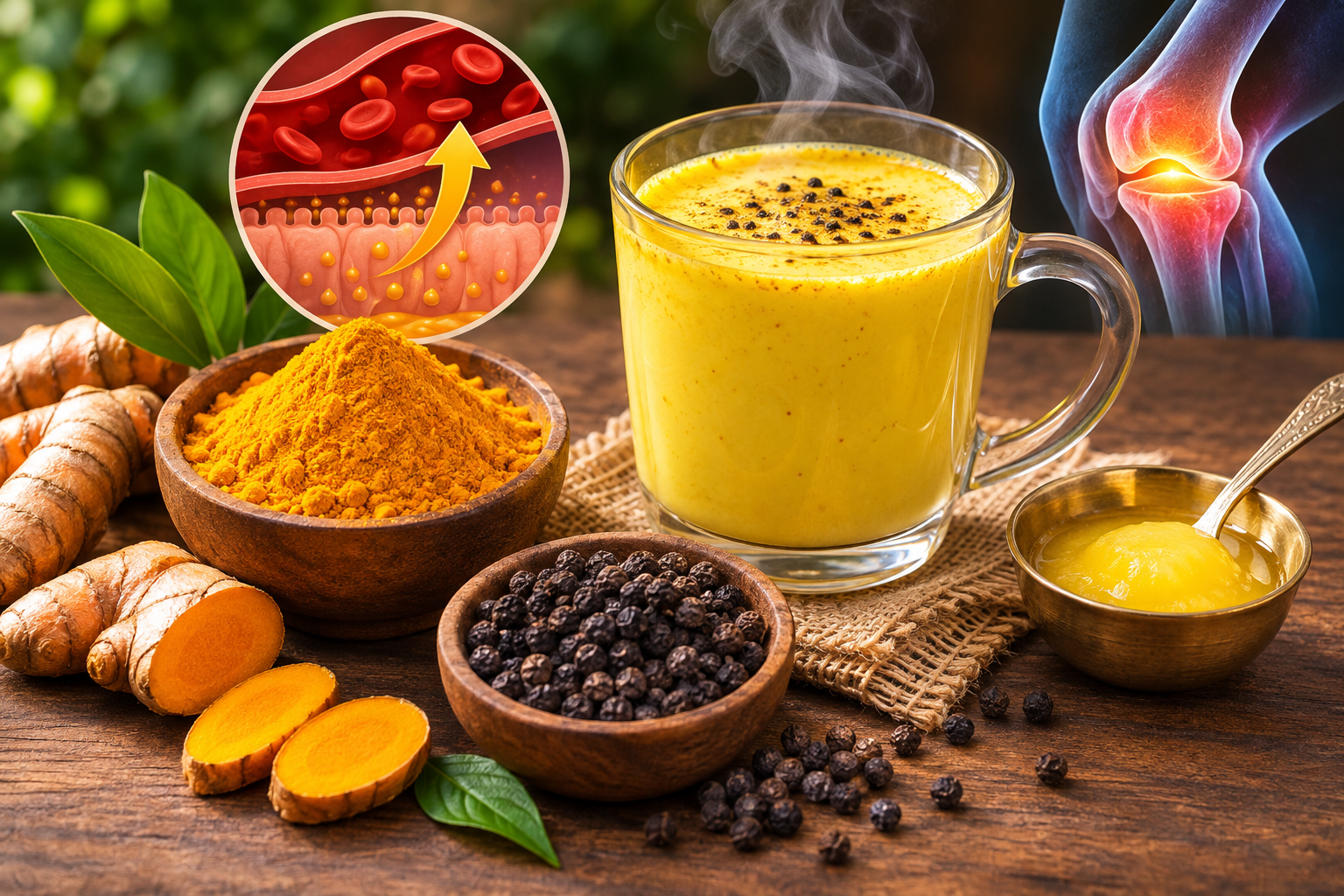
Turmeric and Black Pepper at a Glance
| Feature | Turmeric (Haridra) | Black pepper (Maricha) |
|---|---|---|
| Botanical name | Curcuma longa L. | Piper nigrum L. |
| Family | Zingiberaceae (ginger family) | Piperaceae |
| Part used | Rhizome (root) | Dried fruit (peppercorn) |
| Key compound | Curcumin – about 3% of turmeric powder by weight | Piperine – the compound that gives pepper its heat |
| Taste (Rasa) | Bitter, pungent | Pungent |
| Potency (Virya) | Hot (Ushna) | Hot (Ushna) |
| Dosha effect | Balances Kapha and Pitta | Balances Kapha and Vata; increases Pitta in excess |
| Main role together | The active medicine | The absorption booster |
| Usual kitchen amount | ½–1 teaspoon a day | A pinch with each turmeric dose |
Why Your Body Absorbs So Little Curcumin
Curcumin is the yellow compound behind most of turmeric’s anti-inflammatory and antioxidant effects. The problem is that very little of it reaches your bloodstream when you eat turmeric alone. In the 1998 study below, people who took 2 g of pure curcumin had blood levels that were undetectable or very low.
Three things work against curcumin:
- It does not dissolve in water. Curcumin is fat-soluble, so in plain water much of it passes through the gut unabsorbed.
- Your gut and liver break it down fast. Enzymes attach a glucuronide tag to curcumin (a process called glucuronidation), which marks it for quick removal.
- It is cleared quickly. The small amount that is absorbed leaves the blood within a few hours.
There is also a dose gap. Half a teaspoon of turmeric powder (about 1.5 g) contains only around 45 mg of curcumin, while most research uses 500 mg to 2 g of curcumin extract. This is why helping your body absorb the curcumin you eat matters so much.
How Black Pepper and Fat Help
Piperine slows the breakdown of curcumin
Piperine, the compound that makes black pepper hot, blocks the gut and liver enzymes that tag curcumin for removal. As a result, curcumin stays in the body longer and more of it reaches the blood.
The “20 times” study, explained honestly
The famous figure comes from a small study by Shoba and colleagues, published in Planta Medica in 1998 (PubMed):
- Who: 10 healthy male volunteers, plus a separate test in rats.
- What: 2 g of curcumin alone, compared with 2 g of curcumin plus 20 mg of piperine extract.
- Result in humans: curcumin alone gave very low or undetectable blood levels; with piperine, curcumin absorption rose by 2000% – about 20 times.
- Result in rats: a smaller rise of 154%.
Three points keep this result in perspective:
- The study used a standardised piperine extract, not kitchen pepper. A pinch of ground pepper gives only a few milligrams of piperine, so expect a smaller boost.
- It measured blood levels, not health benefits. Higher absorption is a good sign, but it does not by itself prove better results.
- It was one small study. Later research shows that piperine helps, but the size of the boost varies between people and products.
Fat helps too
Curcumin dissolves in fat, so taking turmeric with ghee, milk, coconut oil or a meal that contains fat helps it get absorbed through the gut wall. This is one reason traditional recipes like haldi doodh (turmeric milk) and tadka (tempering in ghee or oil) work well.
Does heat destroy curcumin?
Short cooking, such as a tadka or simmering milk for a few minutes, is fine. Long, high-heat cooking breaks down part of the curcumin, so add turmeric towards the end when you can.
The Ayurvedic View: Haridra and Maricha
Ayurveda has used turmeric and black pepper together for centuries, long before piperine was discovered. Classical texts do not describe “absorption” in modern terms, but they use pungent herbs like black pepper to improve digestion (Agni) and to help other herbs act better.
Haridra (Turmeric)
- Rasa (taste): Tikta (bitter), Katu (pungent)
- Guna (qualities): Ruksha (dry), Laghu (light)
- Virya (potency): Ushna (hot)
- Vipaka (post-digestive effect): Katu (pungent)
- Dosha effect: balances Kapha and Pitta
- Charaka’s groups: Lekhaniya (reduces excess fat), Kushthaghna (skin diseases), Kandughna (itching) and Vishaghna (anti-toxic)
- Key actions: Varnya (improves complexion), Pramehaghna (useful in Prameha, including diabetes), Vranaropana (heals wounds), Shothahara (reduces swelling)
Maricha (Black Pepper)
- Rasa: Katu (pungent)
- Guna: Laghu (light), Tikshna (sharp)
- Virya: Ushna (hot)
- Vipaka: Katu (pungent)
- Dosha effect: balances Kapha and Vata; increases Pitta in excess
- Key actions: Deepana and Pachana (kindles digestion and digests Ama), Chhedana (cuts through mucus); it is one of the three spices in Trikatu
Why the pair works in Ayurveda
Turmeric is bitter, dry and slightly heavy on a weak digestion, while pepper is sharp and kindles Agni. Together they clear Kapha and Ama (undigested toxins), which is why the pair is used for cough, cold, joint swelling and sluggish digestion. Modern research on piperine as a “bioenhancer” fits this traditional idea that black pepper helps other herbs work.
Benefits of Turmeric With Black Pepper
Black pepper does not add new benefits of its own here; it helps more of turmeric’s curcumin reach your body. Each benefit below shows what Ayurveda says and how strong the modern evidence is.
1. Joint pain and knee osteoarthritis
This is the best-studied use. In a randomised, placebo-controlled trial of 70 people with knee osteoarthritis, a turmeric extract taken for 12 weeks reduced knee pain more than placebo, and participants used fewer painkillers (Wang et al., Annals of Internal Medicine). It did not change swelling inside the joint or cartilage on MRI. A 2018 meta-analysis also found that curcumin and boswellia reduced knee osteoarthritis pain. Ayurveda uses turmeric for Shotha (swelling) and Sandhivata (osteoarthritis).
2. Inflammation
Curcumin lowers inflammatory signals in lab and animal studies, and several small human trials show reductions in inflammation markers. Piperine matters most here, because without it very little curcumin reaches the tissues.
3. Cough, cold and sore throat
Turmeric milk with a pinch of black pepper is a classic Indian home remedy for cough and sore throat, and both herbs are Kapha-reducing in Ayurveda. This use is based on tradition; clinical trials are limited.
4. Digestion and gas
Black pepper kindles digestion (Deepana), and turmeric supports bile flow. Together they are used in Ayurveda for bloating and sluggish digestion. People with acidity or ulcers may find pepper irritating.
5. Blood sugar support
Ayurveda uses turmeric in Prameha, often as Nishamalaki (turmeric with amla). Some small human trials of curcumin show modest improvements in fasting blood sugar. It can add to the effect of diabetes medicines, so monitor your sugar levels.
6. Skin health
Turmeric is Varnya (good for complexion) and Kushthaghna (useful in skin diseases), and is used both in food and in face packs. Evidence for taking it by mouth for skin is mostly traditional or from lab studies.
7. Antioxidant support
Curcumin is a strong antioxidant in the lab. Whether this matters at kitchen doses in people is not yet clear.
Evidence summary
| Benefit | Type of evidence |
|---|---|
| Better curcumin absorption with piperine | Human study (small) |
| Knee osteoarthritis pain | Randomised trials and meta-analysis |
| Inflammation markers | Small human trials, lab studies |
| Blood sugar | Small human trials |
| Cough, cold, digestion | Traditional use |
| Skin, antioxidant | Lab studies, traditional use |
How to Take Turmeric With Black Pepper
The right ratio
For kitchen use, a simple ratio works well: ½ teaspoon turmeric to a pinch (about ⅛ teaspoon or less) of black pepper, plus a little fat. More pepper does not mean more benefit, and too much can irritate the stomach.
Golden milk (Haldi Doodh)
- Warm 1 cup (200 ml) of milk in a pan.
- Add ½ teaspoon turmeric powder, a pinch of freshly ground black pepper and ½ teaspoon ghee.
- Simmer gently for 3–5 minutes; do not boil hard for long.
- Turn off the heat, let it cool slightly and add a little jaggery or honey if you like. Add honey only when the milk is warm, not hot.
- Drink it warm, preferably at night.
You can add a small piece of ginger or a pinch of cinnamon for cough and cold.
Turmeric water (for those who avoid milk)
Mix ½ teaspoon turmeric, a pinch of black pepper and a few drops of ghee or coconut oil in a cup of warm water. Stir well before drinking, as turmeric settles at the bottom.
In everyday cooking
Adding turmeric and black pepper together to dal, sabzi or a tadka in ghee or oil is one of the easiest ways to get both. Add turmeric towards the end of cooking when you can.
Supplements
Curcumin capsules often contain piperine (sold as BioPerine) or use other absorption methods. These give much higher doses than food, so take them only on a doctor’s advice and for a limited period (see the safety section).
Best time to take it
- Turmeric milk: at night, about an hour after dinner.
- Turmeric water or capsules: with or after a meal, to protect the stomach and help absorption.
- Avoid taking it on an empty stomach if you get acidity.
Dosage
| Form | Usual adult amount |
|---|---|
| Turmeric powder in food or milk | ½–1 teaspoon (about 1.5–3 g) a day |
| Black pepper with it | A pinch with each turmeric dose |
| Fresh turmeric root | 1–2 cm piece a day, grated |
| Curcumin supplements | As per label and only on a doctor’s advice; trials commonly use 500–1,000 mg a day |
Children need smaller amounts; a pinch of turmeric in warm milk is usually enough.
Turmeric Recipe for Joint Pain
This warm drink combines turmeric with dry ginger (Shunthi) and black pepper, a classic Ayurvedic trio for Vata-Kapha joint pain and stiffness.
You need:
- ½ teaspoon turmeric powder
- ¼ teaspoon dry ginger powder (sonth)
- A pinch of black pepper
- ½ teaspoon ghee
- 1 cup milk (or warm water)
Method:
- Simmer all the ingredients in the milk for 3–5 minutes.
- Strain if you like, and drink warm at night.
- Continue daily for 6–8 weeks and track how your joints feel.
External support: mix 1 teaspoon turmeric with enough warm mustard or sesame oil to make a paste. Apply on the painful joint for 20–30 minutes, then wash off. Do not apply on broken skin.
When to see a doctor: if the joint is red, hot or very swollen, if pain wakes you at night, or if you have rheumatoid arthritis or gout. Turmeric can support treatment for these conditions but cannot replace it.
Side Effects and Who Should Be Careful
Turmeric and black pepper in normal food amounts are safe for most people. The risks come mainly from high-dose supplements, and from the fact that piperine also increases the absorption of some medicines.
Possible side effects
- Acidity, heartburn or stomach upset, especially from black pepper or when taken on an empty stomach
- Loose stools or nausea with high doses
- Skin rash in people allergic to turmeric (rare)
- Liver injury (rare, supplements only): the US Drug-Induced Liver Injury Network reported ten cases of turmeric-associated liver injury, with many products containing black pepper extract (Halegoua-DeMarzio et al., American Journal of Medicine, 2023). Most people recovered after stopping the supplement. Stop and see a doctor if you notice yellow eyes, dark urine, itching or unusual tiredness.
Who should avoid it or ask a doctor first
- People on blood thinners (warfarin, aspirin, clopidogrel): curcumin may increase bleeding risk; stop supplements about two weeks before surgery.
- People with gallstones or bile duct problems: curcumin makes the gallbladder contract.
- People on diabetes medicines: turmeric may lower blood sugar further.
- People on any regular medicine: piperine changes how the liver processes many drugs (including some for epilepsy, asthma and tuberculosis), so check with your doctor before taking piperine supplements.
- People with frequent acidity, gastritis or ulcers: go easy on black pepper and take turmeric after meals.
- People with liver disease: avoid high-dose curcumin supplements.
- People with low iron or anaemia: large amounts of turmeric may reduce iron absorption; avoid taking it with iron tablets.
- Pregnant and breastfeeding women: turmeric in food is fine, but avoid supplements and medicinal doses.
- People with kidney stones: turmeric contains oxalates; avoid large supplemental doses.
Myths vs Facts
| Myth | Fact |
|---|---|
| A pinch of pepper makes turmeric 20 times stronger. | The 20x figure came from 20 mg of piperine extract with 2 g of curcumin. A kitchen pinch helps, but by much less. |
| Turmeric is useless without black pepper. | Some curcumin is still absorbed, especially with fat or milk, and turmeric has other active compounds. Pepper simply helps more of it work. |
| More pepper means more benefit. | A pinch is enough. Extra pepper adds heat and can cause acidity. |
| Turmeric water on an empty stomach is best. | Curcumin is fat-soluble, so it absorbs better with a meal or with ghee or milk. |
| If turmeric is safe in food, high-dose capsules are safe too. | Concentrated curcumin with piperine has been linked to rare liver injury and drug interactions. |
| Turmeric can replace arthritis or diabetes medicines. | It can support treatment, but it is not a replacement. Never stop prescribed medicines on your own. |
Scientific Research
The studies below are the main evidence behind this article. Human trials so far are small or short, so larger and longer studies are still needed.
- Piperine and curcumin absorption (human and animal): 20 mg of piperine with 2 g of curcumin increased curcumin bioavailability by 2000% in 10 healthy volunteers and by 154% in rats, with no adverse effects. Shoba G, Joy D, Joseph T, Majeed M, Rajendran R, Srinivas PS. Planta Medica, 1998; 64(4): 353–356. PubMed
- Knee osteoarthritis (randomised controlled trial): in 70 people, a turmeric extract for 12 weeks reduced knee pain compared with placebo, but did not change joint swelling or cartilage on MRI. Wang Z et al. Annals of Internal Medicine, 2021 (online September 2020). Abstract
- Knee osteoarthritis (meta-analysis): curcumin and boswellia reduced pain and improved function in knee osteoarthritis. Bannuru RR, Osani MC, Al-Eid F, Wang C. Seminars in Arthritis and Rheumatism, 2018; 48(3): 416–429.
- Knee osteoarthritis (randomised controlled trial): a turmeric extract was safe and reduced pain in painful knee osteoarthritis. Madhu K, Chanda K, Saji MJ. Inflammopharmacology, 2013; 21(2): 129–136.
- Liver safety (case series): ten cases of liver injury linked to turmeric supplements in the US Drug-Induced Liver Injury Network, rising in recent years and often with black pepper extract. Halegoua-DeMarzio D et al. American Journal of Medicine, 2023; 136(2): 200–206.
- Liver safety (case reports): two cases of turmeric-induced liver injury that resolved after stopping, one with a turmeric–piperine supplement. Sohal A et al. International Medical Case Reports Journal, 2021. Read
- Liver safety (case report): liver injury in a 35-year-old man after six weeks of a turmeric supplement with piperine. Koo N, Kambhampati H, Herman M. Cureus, 2025. Read on PMC
Frequently Asked Questions (FAQs)
Why should turmeric be taken with black pepper?
Your body absorbs very little curcumin on its own. Piperine in black pepper slows its breakdown in the gut and liver, so more curcumin reaches your blood.
How much black pepper should I add to turmeric?
A small pinch (⅛ teaspoon or less) with ½ teaspoon of turmeric is enough. More pepper does not add more benefit.
Does black pepper really increase turmeric absorption 20 times?
In a 1998 study, 20 mg of piperine extract increased curcumin absorption about 20 times. A kitchen pinch contains much less piperine, so the boost is smaller but still useful.
Is it better to take turmeric with milk or water?
Milk is better, because curcumin dissolves in fat. If you use water, add a few drops of ghee or coconut oil.
What is the best time to take turmeric with black pepper?
Turmeric milk is best at night, about an hour after dinner. Turmeric water or capsules are best taken with or after a meal.
Can I take turmeric and black pepper every day?
Yes, in food amounts – ½ to 1 teaspoon of turmeric with a pinch of pepper – it is safe for most healthy adults. High-dose supplements should be taken only on a doctor’s advice and for a limited time.
Can I drink turmeric milk with black pepper at night?
Yes. Warm turmeric milk with a pinch of black pepper and a little ghee is a traditional night-time drink for cough, cold, body aches and better sleep.
Does turmeric with black pepper help joint pain?
Turmeric extract reduced knee osteoarthritis pain in clinical trials. Adding black pepper helps more curcumin get absorbed. It works slowly, so give it 6–8 weeks.
Can turmeric with black pepper help weight loss?
There is no strong evidence that it causes weight loss on its own. It may support digestion and reduce inflammation as part of a healthy diet and exercise.
Can diabetics take turmeric with black pepper?
Yes, in food amounts. It may lower blood sugar slightly, so people on diabetes medicines should monitor their sugar and talk to their doctor before taking supplements.
Who should not take turmeric with black pepper?
People on blood thinners, people with gallstones, liver disease or frequent acidity, and people on regular medicines should check with a doctor first. Pregnant women should avoid supplements.
Can turmeric with black pepper cause acidity?
Black pepper can trigger acidity or heartburn in some people. Take it after meals, use only a pinch, and add milk or ghee.
Is turmeric with black pepper safe for the liver?
Kitchen amounts are safe for most people. High-dose curcumin supplements with piperine have been linked to rare liver injury, so avoid them if you have liver disease.
Can I take turmeric with black pepper during pregnancy?
Turmeric and pepper in normal cooking are fine during pregnancy. Avoid curcumin supplements and large medicinal doses unless your doctor advises them.
Can children have turmeric milk with black pepper?
Children can have a pinch of turmeric in warm milk. Skip the black pepper for young children, or use only a tiny pinch.
Does cooking destroy curcumin?
Short cooking is fine. Long, high-heat cooking breaks down some curcumin, so add turmeric towards the end of cooking.
Which is better, raw turmeric or turmeric powder?
Both work. Fresh turmeric root has a milder taste and contains the same curcumin; powder is more concentrated and convenient.
Are turmeric capsules with piperine better than kitchen turmeric?
Capsules give much higher doses of curcumin and are what clinical trials use. They also carry more risk of side effects and drug interactions, so use them only under medical guidance.
Can I mix turmeric, black pepper and honey?
Yes. Honey with turmeric and a pinch of pepper is a traditional remedy for cough and sore throat. Do not mix honey into very hot water or milk.
Is turmeric with black pepper good for the skin?
Turmeric is used in Ayurveda for clear skin, both in food and in face packs. Do not put black pepper in face packs, as it can irritate the skin.
Conclusion
Turmeric’s curcumin is powerful but poorly absorbed, and black pepper’s piperine is the simplest kitchen fix. A pinch of pepper and a little ghee or milk with ½ teaspoon of turmeric is all you need; the famous 20x boost came from an extract, but even a pinch helps. Food amounts are safe for most people, while high-dose curcumin–piperine supplements need a doctor’s advice because of rare liver injury and drug interactions. Ayurveda has paired Haridra and Maricha for centuries, and modern research now explains part of why.
Medical disclaimer: This article is for educational purposes only and is not a substitute for advice, diagnosis or treatment from a qualified doctor.
Related reading: Amla: Benefits, Uses and Dosage · Palash Flower Benefits, Uses and Kamarkas