
Ashwagandha for Stress and Sleep: Benefits, Dosage, Best Time and Side Effects
Ashwagandha (Withania somnifera) is Ayurveda’s most trusted herb for stress and poor sleep. It is an adaptogen, a herb that helps the body cope with stress. In randomized clinical trials, adults who took ashwagandha root extract for about 8 weeks had lower cortisol (the main stress hormone), less perceived stress and better sleep quality than those on placebo. A 2021 meta-analysis of 5 trials found it improved sleep, with the best results at 600 mg a day or more for at least 8 weeks.
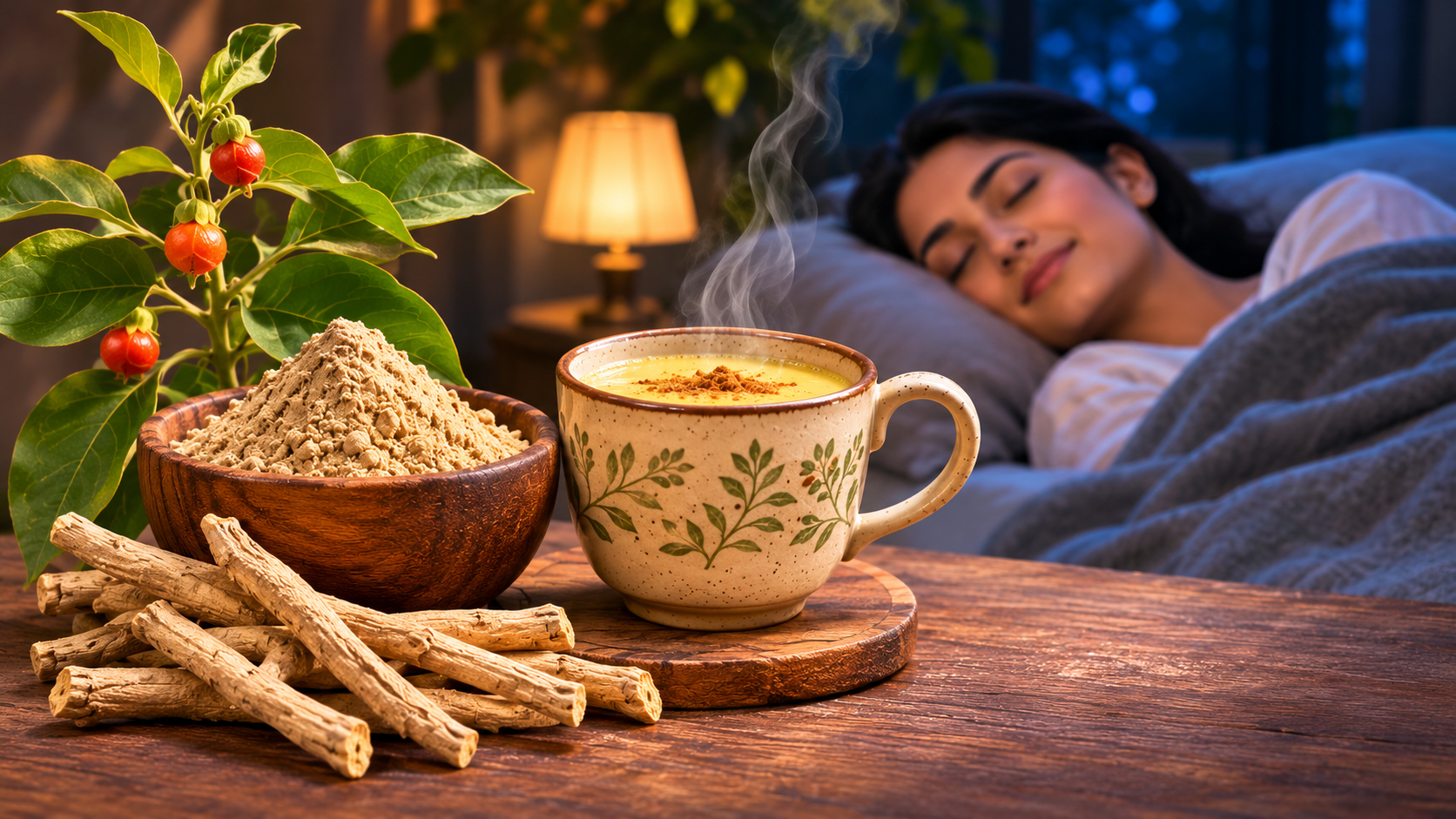
- How to take: ½ teaspoon of ashwagandha root powder in a cup of warm milk at night, or a standardised root extract (250–600 mg a day) as used in studies.
- How fast: it is not a sleeping pill. Most people notice a change after 2–4 weeks; trials measured results at 8 weeks.
- Avoid or ask a doctor first: pregnancy, thyroid medicine, autoimmune disease, liver disease, and if you take sleeping pills, anxiety medicines, or diabetes or blood pressure medicines.
- Use the root only: in April 2026 India’s FSSAI barred ashwagandha leaves from food products; buy products made from the root.
Medically reviewed by: Dr. Arun Jharwal, BAMS, MD (Ayurveda)
Ashwagandha at a Glance
| Feature | Details |
|---|---|
| Botanical name | Withania somnifera (L.) Dunal |
| Family | Solanaceae (tomato and potato family) |
| Common names | Ashwagandha, Asgandh (Hindi); Indian ginseng, Winter cherry (English) |
| Meaning of the name | Ashva = horse, gandha = smell; the fresh root smells like a horse, and it is said to give the strength of a horse |
| Part used | Root |
| Key compounds | Withanolides (such as withanolide A) and alkaloids |
| Ayurvedic class | Rasayana (rejuvenator) and Balya (strength-giving) |
| Potency in Ayurveda | Ushna (warming) |
| Common dose | ½–1 teaspoon root powder (about 1.5–3 g) at night, or 250–600 mg root extract a day |
| Time to work | Gradual; studies measured benefits at 8 weeks |
Stress, Cortisol and Sleep: Why You Can’t Switch Off at Night
When you are under stress, your adrenal glands release cortisol. In short bursts it is useful: it raises energy and sharpens attention. The problem is constant stress, when cortisol stays high for weeks.
Normally cortisol is highest in the morning and lowest at night, which lets you fall asleep. With ongoing stress this rhythm gets disturbed, and the result is the familiar pattern:
- A racing mind when you lie down, and difficulty falling asleep
- Waking up at 2–3 a.m. and not getting back to sleep
- Feeling tired but wired during the day
- Sugar cravings and fat gain around the belly, which research links to long-term high cortisol
- Irritability, poor focus and low energy
Poor sleep then raises stress further, and the cycle repeats. Sleeping pills can force sleep, but they do not address the stress behind it. This is where adaptogens like ashwagandha come in: the aim is to calm the stress response itself so that sleep improves naturally.
The Ayurvedic View: Ashwagandha as Rasayana
Ashwagandha has been used in Ayurveda for more than 2,000 years and appears in the Charaka Samhita among herbs that build strength (Balya) and nourish the body (Brimhaniya). Its species name somnifera is Latin for “sleep-inducing”.
Properties of Ashwagandha
- Rasa (taste): Tikta (bitter), Kashaya (astringent)
- Guna (qualities): Laghu (light), Snigdha (unctuous)
- Virya (potency): Ushna (warming)
- Vipaka (post-digestive effect): Madhura (sweet)
- Dosha effect: calms Vata and Kapha
- Key actions: Rasayana (rejuvenating), Balya (strength-giving), Medhya (supports the mind), Shukrala (supports reproductive health)
Why Ayurveda uses it for stress and sleep
In Ayurveda, anxiety, a restless mind and insomnia (Anidra) are mainly signs of aggravated Vata, which is light, dry and mobile. Ashwagandha is warm, unctuous and grounding, so it settles Vata and nourishes the nervous system. That is why it is traditionally given at night with warm milk and ghee, both of which also calm Vata.
It is often combined with other Medhya herbs such as Brahmi, Jatamansi and Shankhpushpi for anxiety and sleep problems.
What the Research Says: Cortisol, Stress and Sleep
Ashwagandha is one of the best-studied Ayurvedic herbs. Most trials were small, run in India, and used concentrated root extracts rather than plain powder, but the results are consistent.
Cortisol and stress
- Chandrasekhar et al., 2012: 64 stressed adults took 300 mg of root extract twice a day or placebo for 60 days. Serum cortisol fell by about 28% in the ashwagandha group, along with clear drops on stress and anxiety scales.
- Salve et al., 2019: 60 healthy adults took 250 mg or 600 mg of root extract a day for 8 weeks. Both doses lowered perceived stress and cortisol compared with placebo, and the 600 mg dose worked best (cortisol fell from about 16.1 to 10.9 mcg/dL).
- Lopresti et al., 2019: 60 mildly anxious adults took 240 mg of a standardised extract for 60 days. Anxiety scores and morning cortisol fell compared with placebo.
Sleep
- Langade et al., 2019: adults with insomnia took 300 mg of root extract twice a day for 10 weeks. They fell asleep faster and slept more efficiently than the placebo group.
- Salve et al., 2019: sleep quality improved at both doses after 8 weeks.
- Cheah et al., 2021 (meta-analysis): 5 randomized trials with 400 participants. Ashwagandha produced a small but significant improvement in overall sleep. The effect was larger in people with insomnia, at doses of 600 mg a day or more, and with treatment of 8 weeks or longer. It also reduced anxiety and improved mental alertness on waking.
Evidence summary
| Use | Strength of evidence |
|---|---|
| Lowering stress and cortisol | Moderate: several randomized trials |
| Better sleep quality | Moderate: randomized trials and a meta-analysis |
| Anxiety | Moderate: randomized trials and meta-analyses |
| Instant sleep like a sleeping pill | Not supported: benefits build over weeks |
Other Benefits of Ashwagandha
- Anxiety: a 2022 meta-analysis of randomized trials (Akhgarjand et al.) found ashwagandha reduced anxiety and stress scores compared with placebo.
- Strength and recovery: in an 8-week trial in young men doing resistance training, ashwagandha increased muscle strength and size more than placebo (Wankhede et al., 2015). This matches its Ayurvedic role as Balya.
- Male fertility: small trials found improved sperm count and motility in men with low sperm counts (Ambiye et al., 2013).
- Energy and fatigue: better sleep and lower stress often mean better daytime energy, which several trials reported.
- Thyroid: in a small trial in people with subclinical hypothyroidism, ashwagandha raised thyroid hormone levels (Sharma et al., 2018). This is why people already on thyroid medicine should not take it without medical advice.
How to Take Ashwagandha for Stress and Sleep
1. Ashwagandha milk (traditional bedtime method)
- Warm 1 cup of milk (dairy, or a plant milk if you prefer).
- Stir in ½ teaspoon of ashwagandha root powder.
- Add a pinch of nutmeg or cardamom and ½ teaspoon of ghee or a little jaggery if you like.
- Simmer for 2–3 minutes and drink warm, about 30–60 minutes before bed.
The powder has an earthy, bitter taste. Milk, ghee and a sweetener make it easier to drink, and in Ayurveda they also help carry the herb and calm Vata.
2. Capsules or tablets (standardised extract)
The clinical trials used root extracts, mostly at 250–600 mg a day, often split into two doses. Extracts are concentrated, so a capsule is not the same as the same weight of powder. If you want results similar to the studies, choose a standardised root extract and follow the label.
3. Ashwagandha churna with honey or ghee
If you do not drink milk, mix the powder with a teaspoon of ghee or honey and follow it with warm water.
Best time to take it
- For sleep: at night, 30–60 minutes before bed.
- For daytime stress: split into morning and night doses, as in many trials.
- With food: taking it after a meal or with milk reduces the chance of an upset stomach.
Dosage
| Form | Common amount |
|---|---|
| Root powder (churna) | ½–1 teaspoon (about 1.5–3 g) a day; the Ayurvedic Pharmacopoeia of India lists 3–6 g a day |
| Standardised root extract | 250–600 mg a day, as used in clinical trials |
| Ashwagandha milk | 1 cup at night with ½ teaspoon powder |
Start with the lower amount for a week to check how your body responds. Most trials lasted 8–12 weeks; if you want to continue beyond 3 months, review it with an Ayurvedic doctor.
How long does it take to work?
Ashwagandha is not an instant sleep aid. Some people sleep a little better within 1–2 weeks, but trials measured clear changes in cortisol and sleep at 8 weeks. Take it daily and give it at least a month before judging.
Ashwagandha vs Melatonin vs Sleeping Pills vs Chamomile
| Option | How it works | Best for | Limitations |
|---|---|---|---|
| Ashwagandha | Calms the stress response and lowers cortisol over time | Stress-related poor sleep, anxiety, tiredness | Takes weeks; not for pregnancy, some thyroid, liver and autoimmune conditions |
| Melatonin | Signals the body clock that it is night | Jet lag, shift work, a delayed sleep cycle | Does little for stress or a racing mind; use only with medical advice |
| Sleeping pills | Sedate the brain directly | Short-term, doctor-supervised use | Risk of dependence, morning grogginess; do not treat the cause |
| Chamomile tea | Mild calming effect | A gentle bedtime ritual | Studies are small and results are mixed; effect is mild |
The key difference: melatonin and sleeping pills act on sleep itself, while ashwagandha works on the stress behind poor sleep. If stress is what keeps you awake, ashwagandha targets the root cause. Do not combine ashwagandha with sleeping pills or anxiety medicines without your doctor’s advice, because the sedative effects can add up.
Side Effects and Who Should Avoid Ashwagandha
At usual doses for a few months, ashwagandha is well tolerated by most adults. Side effects are generally mild.
Possible side effects
- Drowsiness, which is why night-time use suits most people
- Upset stomach, loose stools or nausea, especially on an empty stomach
- Headache
- Liver injury (rare): case reports, including a 2020 series of five patients, describe jaundice and liver injury linked to ashwagandha supplements. Stop it and see a doctor if you notice yellow eyes, dark urine, itching or pain in the upper right abdomen.
- Thyroid changes: it can raise thyroid hormone levels.
Who should avoid it
- Pregnant women: high doses have been used traditionally to cause abortion. Do not take it during pregnancy.
- People with liver disease.
- People with hyperthyroidism (overactive thyroid).
Who should ask a doctor first
- People taking thyroid medicine such as thyroxine
- People with autoimmune diseases such as rheumatoid arthritis, lupus or multiple sclerosis, because ashwagandha may stimulate the immune system
- People taking sleeping pills, anxiety medicines or anti-epileptics (combined drowsiness)
- People on diabetes or blood pressure medicines (it may lower blood sugar and blood pressure)
- People on immunosuppressants after a transplant
- Breastfeeding mothers (safety data are limited)
- Men with hormone-sensitive prostate cancer, as it may raise testosterone
- Anyone with surgery planned: stop it 2 weeks before, because it can add to the effects of anaesthesia
A note on global safety reviews
Denmark banned ashwagandha in supplements in 2023, and food-safety agencies in the Netherlands, France and the UK have issued warnings or reviews, mainly over liver, thyroid and pregnancy concerns. India’s FSSAI in April 2026 barred the use of ashwagandha leaves in food products and allowed only the root. For most healthy adults, short-term use of a good-quality root product is considered reasonably safe, but these reviews are a good reason to respect the cautions above and not take it indefinitely without supervision.
How to Choose a Good Ashwagandha Product
- Root only: check the label says “root” or “root extract”. Avoid products made from leaves or “whole plant”.
- Standardised extract: for capsules, look for a stated withanolide content (often 2.5–5%) and a dose of 250–600 mg.
- Trusted brand: choose an established Ayurvedic or supplement company with GMP certification and an AYUSH licence number on the pack.
- Fresh powder: churna should smell earthy and slightly horse-like; a stale, musty smell means it is old.
- No hidden sedatives: avoid unknown “sleep” blends that do not list every ingredient.
Myths vs Facts
| Myth | Fact |
|---|---|
| Ashwagandha works like a sleeping pill on the first night. | It works gradually. Trials measured clear benefits after about 8 weeks of daily use. |
| Since it is herbal, it is safe for everyone. | It should be avoided in pregnancy and needs medical advice with thyroid, liver and autoimmune conditions. |
| More is better. | Studies used 250–600 mg of extract a day. Higher doses add side-effect risk without proven extra benefit. |
| Ashwagandha leaves are just as good. | Clinical evidence is mainly for the root, and India now allows only the root in food products. |
| Its name means it makes you as strong as a horse. | Ashva-gandha literally means “horse smell”, from the root’s odour; the strength link is traditional. |
| You can take it with sleeping pills for a stronger effect. | Combining sedatives increases drowsiness risk. Ask your doctor first. |
Frequently Asked Questions (FAQs)
Does ashwagandha really help with sleep?
Yes, moderately. A 2021 meta-analysis of 5 randomized trials found it improved sleep quality, especially in people with insomnia, at 600 mg a day or more of root extract taken for at least 8 weeks.
Does ashwagandha reduce cortisol?
In several trials, adults taking root extract for 8 weeks had significantly lower serum cortisol than those on placebo, with reductions of roughly a quarter to a third in some studies.
What is the best time to take ashwagandha for sleep?
At night, 30–60 minutes before bed, ideally with warm milk or after dinner.
How much ashwagandha should I take for stress?
A common starting amount is ½ teaspoon of root powder a day. Trials used 250–600 mg of standardised root extract a day. Follow the label of your product or your Ayurvedic doctor’s advice.
How long does ashwagandha take to work?
Some people notice better sleep in 1–2 weeks, but studies measured clear benefits at about 8 weeks of daily use.
Can I take ashwagandha every day?
Yes, for up to about 3 months, which is how long most trials lasted. For longer use, check with an Ayurvedic doctor.
Can I take ashwagandha with milk?
Yes. This is the traditional Ayurvedic way, especially at night. Milk and a little ghee make it easier to digest and calm Vata.
Can I take ashwagandha without milk?
Yes. Take the powder with warm water, honey or ghee, or use capsules after a meal.
Is ashwagandha better than melatonin?
They do different jobs. Melatonin resets the body clock (useful for jet lag or shift work), while ashwagandha calms stress. If stress keeps you awake, ashwagandha suits the cause better.
Is ashwagandha habit-forming?
There is no evidence that it causes dependence or withdrawal like sleeping pills.
Does ashwagandha cause weight gain?
It does not directly cause weight gain. Some people eat better as stress falls; taking it with sweetened milk adds calories, so watch portions.
Can women take ashwagandha?
Yes, adult women can take it, but not during pregnancy. Breastfeeding mothers should ask a doctor first.
Is ashwagandha safe with thyroid problems?
It can raise thyroid hormone levels. Avoid it if you have an overactive thyroid, and ask your doctor before using it if you take thyroid medicine.
Is ashwagandha bad for the liver?
Liver injury is rare but has been reported. Avoid it if you have liver disease, and stop it if you notice yellow eyes, dark urine or itching.
Can ashwagandha be taken with sleeping pills?
Not without your doctor’s advice, because together they can cause too much drowsiness.
Can teenagers take ashwagandha?
There is little research in people under 18. Ask a doctor before giving it to children or teenagers.
Which is better: ashwagandha powder or capsules?
Powder is traditional and cheaper. Standardised root-extract capsules give a measured dose and match what clinical trials used.
Can I take ashwagandha and Brahmi together?
Yes, they are often combined in Ayurveda for stress and sleep, but follow the dose on the product or your doctor’s advice.
Should I take ashwagandha in the morning or at night?
At night for sleep. For daytime stress, many trials split the dose into morning and night.
What does ashwagandha mean?
It means “smell of a horse” in Sanskrit, from the root’s strong odour.
Scientific Research
- Cortisol and stress (60 days): Chandrasekhar K, Kapoor J, Anishetty S. A prospective, randomized double-blind, placebo-controlled study of safety and efficacy of a high-concentration full-spectrum extract of ashwagandha root in reducing stress and anxiety in adults. Indian Journal of Psychological Medicine, 2012.
- Stress, cortisol and sleep (8 weeks): Salve J, Pate S, Debnath K, Langade D. Adaptogenic and anxiolytic effects of ashwagandha root extract in healthy adults. Cureus, 2019; 11(12): e6466. Read on PMC
- Sleep meta-analysis: Cheah KL, Norhayati MN, et al. Effect of Ashwagandha (Withania somnifera) extract on sleep: a systematic review and meta-analysis. PLoS One, 2021; 16(9): e0257843. PubMed
- Insomnia: Langade D, et al. Efficacy and safety of ashwagandha root extract in insomnia and anxiety. Cureus, 2019.
- Anxiety and cortisol: Lopresti AL, et al. An investigation into the stress-relieving and pharmacological actions of an ashwagandha extract. Medicine (Baltimore), 2019.
- Thyroid: Sharma AK, Basu I, Singh S. Efficacy and safety of ashwagandha root extract in subclinical hypothyroid patients. Journal of Alternative and Complementary Medicine, 2018.
- Liver injury: Björnsson HK, et al. Ashwagandha-induced liver injury: a case series from Iceland and the US Drug-Induced Liver Injury Network. Liver International, 2020.
- Regulation: FSSAI advisory on non-use of ashwagandha leaves in food products, April 2026; Danish ban on ashwagandha in supplements, 2023.
Conclusion
Ashwagandha has earned its place as Ayurveda’s go-to herb for stress and sleep. Its traditional role as a Vata-calming Rasayana matches what modern trials show: about 8 weeks of daily root extract lowered cortisol, eased stress and anxiety, and improved sleep quality.
It is not a sleeping pill, though. It works slowly, by calming the stress that keeps you awake. Start with ½ teaspoon of root powder in warm milk at night or a standardised root extract, take it consistently, and pair it with good sleep habits: a fixed bedtime, less screen time at night and less caffeine after noon.
Respect the cautions. Avoid it in pregnancy, and talk to your doctor first if you have a thyroid, liver or autoimmune condition or take sleeping pills or other regular medicines.
Medical Disclaimer
This article is for educational purposes only and is not a substitute for professional medical advice, diagnosis or treatment. If you have ongoing insomnia, anxiety or depression, are pregnant or breastfeeding, have a medical condition or take regular medicines, consult a qualified doctor or Ayurvedic physician before using ashwagandha.
Medically reviewed by: Dr. Arun Jharwal, BAMS, MD (Ayurveda)