
Is Cornflakes and Juice a Healthy Breakfast? The Blood Sugar Trap and Better Indian Swaps
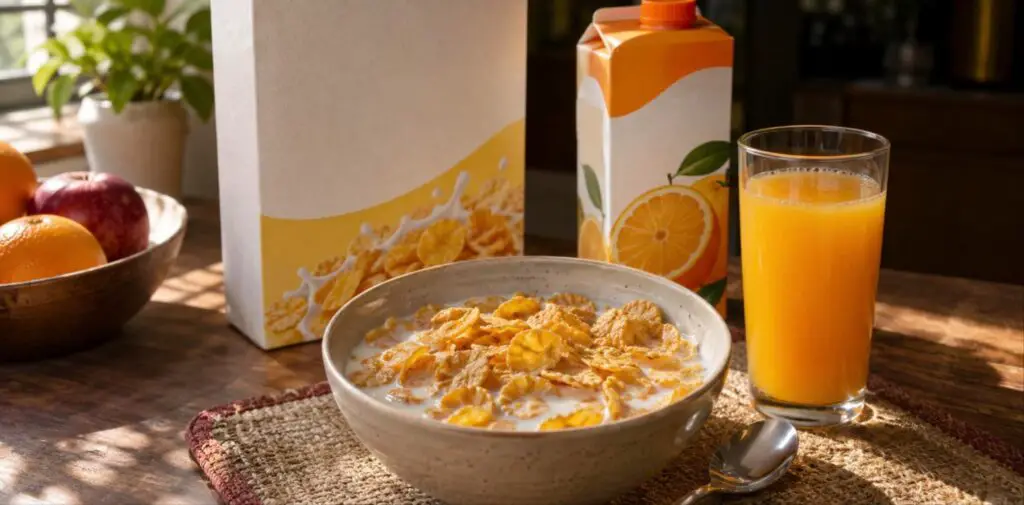
A bowl of cornflakes with a glass of packaged fruit juice looks like a light, healthy breakfast, but it is mostly fast-digesting starch and free sugar, with very little protein or fibre. Cornflakes have a high glycaemic index (about 81), so blood sugar can rise quickly, and in many people it dips again a couple of hours later, bringing mid-morning hunger and sugar cravings. Large studies link regular fruit-juice drinking with a higher risk of type 2 diabetes, while whole fruit is linked with a lower risk.
You do not need to fear cornflakes as “the most dangerous” food. The problem is the combination, eaten daily, without protein. Better Indian breakfasts include besan or moong dal chilla, poha with peanuts and vegetables, eggs, idli with sambar, sprouts, or curd with nuts, with a whole fruit instead of juice.
Medically reviewed by: Dr. Arun Jharwal, BAMS, MD (Ayurveda)
Cornflakes and Juice at a Glance
| Point | Detail |
|---|---|
| Glycaemic index of cornflakes | About 81 (high); white bread is about 75 |
| Plain cornflakes, per 100 g | About 380 kcal, 87 g carbohydrate, 8 g sugar, 2.7 g fibre, 6.7 g protein |
| Flavoured cereals | Chocolate, honey or frosted versions usually contain much more sugar |
| Packaged juice | Free sugar with almost no fibre; easy to drink a lot quickly |
| What research shows | Juice linked with higher diabetes risk; whole fruit with lower risk (Muraki et al., 2013) |
| Why 11 a.m. hunger happens | Low protein and fibre, quick rise and fall in blood sugar in some people |
| Better swaps | Besan or moong chilla, poha with peanuts, eggs, idli-sambar, sprouts, curd with nuts |
| Instead of juice | A whole fruit such as apple, orange, guava or papaya |
| Extra caution for | Diabetes, prediabetes, PCOS, fatty liver, children who skip protein at breakfast |
What Happens to Your Blood Sugar After Cornflakes and Juice?

When you eat refined starch like cornflakes, it breaks down into glucose very quickly. Flaking and toasting make the starch easy to digest, which is why cornflakes score around 81 on the glycaemic index, a scale where pure glucose is 100. Milk slows this a little, but the meal is still mostly carbohydrate.
Packaged juice adds more sugar on top. Because the fibre of the fruit has been removed, a glass of juice gives you the sugar of several fruits in a minute, without the chewing and fullness of whole fruit.
In many people, the result is:
- A quick rise in blood sugar within 30–60 minutes.
- A large insulin response to bring it down.
- A dip a couple of hours later in some people, which can feel like hunger, low energy, irritability or a craving for something sweet.
Not everyone gets a dramatic “crash”, and the size of the spike varies from person to person. But a breakfast that is low in protein and fibre is far less filling, so most people are hungry again by mid-morning.
A Correction on “Morning Insulin Sensitivity”
The script says the body is most sensitive to insulin in the morning, so a sugary breakfast is especially harmful then. The first half is broadly true: in healthy people, glucose tolerance is usually better earlier in the day than late at night. But that actually means the body handles carbohydrates better in the morning, not worse. The real problem is not the time of day, it is the type of breakfast: fast carbohydrates and sugar with little protein, fibre or fat. In people with diabetes, morning blood sugar can run high because of the “dawn phenomenon”, which is another reason a high-GI breakfast is a poor choice for them.
What Is Actually in Cereal and Packaged Juice?
Cornflakes and breakfast cereals
Plain cornflakes are not very high in sugar compared with many other cereals. Per 100 g, a common Indian pack lists about 380 kcal, 87 g carbohydrate, 8 g sugar, 2.7 g fibre and 6.7 g protein. The bigger issues are:
- High glycaemic index. The starch is refined and puffed, so it digests very fast.
- Low protein and fibre. A typical 30–40 g bowl gives only about 2–3 g of protein and around 1 g of fibre before milk, which is why it does not keep you full.
- Flavoured versions. Chocolate, honey, frosted and “kids” cereals often contain far more added sugar than plain cornflakes.
- Health halo. Front-of-pack words like “fortified”, “whole grain” or “high fibre” can make a cereal look healthier than its nutrition panel shows.
Packaged fruit juice
- Free sugar, no fibre. Even “100% juice” with no added sugar counts as free sugar in WHO guidance, because the fibre is removed and the sugar is released quickly.
- Easy to over-drink. One glass can contain the sugar of three or four oranges, without the chewing or fullness.
- “Fruit drinks” and “nectars” often have added sugar on top of juice, and some contain only a small percentage of real fruit.
- Fructose load. Fructose is handled mainly by the liver. In large, regular amounts, especially from drinks, high free-sugar intake is linked with fatty liver and insulin resistance.
How to read the label: check “total sugars” and “added sugars” per serving, the protein and fibre grams, and the ingredient list. Sugar listed near the top, or in several forms (sugar, glucose syrup, honey, malt extract), is a warning sign.
What Does the Research Say?
Fruit juice vs whole fruit and diabetes risk
In three large US cohorts of about 187,000 adults followed for more than two decades, every three servings a week of fruit juice was linked with an 8% higher risk of type 2 diabetes. Whole fruit, by contrast, was linked with a slightly lower risk. Swapping three servings of juice a week for whole fruit was linked with about 7% lower risk (Muraki et al., 2013). These are observational findings, so they show association rather than proof, but they consistently favour whole fruit.
Glycaemic index of common breakfast foods
| Food | Approximate GI |
|---|---|
| Cornflakes | 81 (high) |
| Instant oat porridge | 79 (high) |
| Rolled oats porridge | 55 (low-medium) |
| Orange juice | 50 |
| Apple juice | 41 |
| Whole orange | 43 |
| Whole apple | 36 |
| Chickpeas (basis of besan) | 28 (low) |
Values from the International Tables of Glycemic Index (Atkinson et al., 2008). Juice has a lower GI than cornflakes because fructose raises blood sugar less than glucose, but juice still delivers a lot of free sugar with no fibre.
Protein at breakfast and later hunger
In a randomised crossover study of overweight teenage girls who usually skipped breakfast, a 350 kcal high-protein breakfast (35 g protein, egg- and meat-based) increased fullness more than a cereal-based breakfast with 13 g protein, and led to less evening snacking on high-fat foods (Leidy et al., 2013). This supports the script’s swap idea: adding protein to breakfast helps control hunger later in the day.
Time of day and blood sugar
Research on the body clock shows that glucose tolerance in healthy people generally peaks in the biological morning or around noon, which suggests eating more of your carbohydrates earlier in the day is better than late at night. This does not make a high-sugar breakfast safe, but it does mean the morning itself is not the culprit; the food choice is.
Bottom line: the evidence supports moving away from a daily breakfast of refined cereal and juice towards one with protein, fibre and whole fruit. Calling cornflakes “the most dangerous breakfast in the world” is an exaggeration; a fried, oily breakfast eaten every day has its own serious problems.
The Ayurvedic View of Breakfast
In Ayurveda, the morning is Kapha kala, when the body tends to feel heavy and agni (digestive fire) is still waking up. A good breakfast is therefore warm, light, freshly cooked and easy to digest.
- Cold, processed, packaged foods like cereal with cold milk and chilled juice are seen as heavy for morning agni and can leave you sluggish.
- Warm, freshly cooked foods such as moong dal chilla, poha, upma, daliya or vegetable khichdi suit the morning better.
- Spices like jeera, ajwain, ginger, hing and black pepper support agni.
- Fruit is traditionally eaten whole and on its own, or with a short gap from heavy meals, rather than as juice with milk-based foods.
Ayurveda also advises against eating when not hungry and against heavy, sweet breakfasts every day, which fits the modern advice to avoid sugary, refined breakfasts.
Better Indian Breakfast Swaps
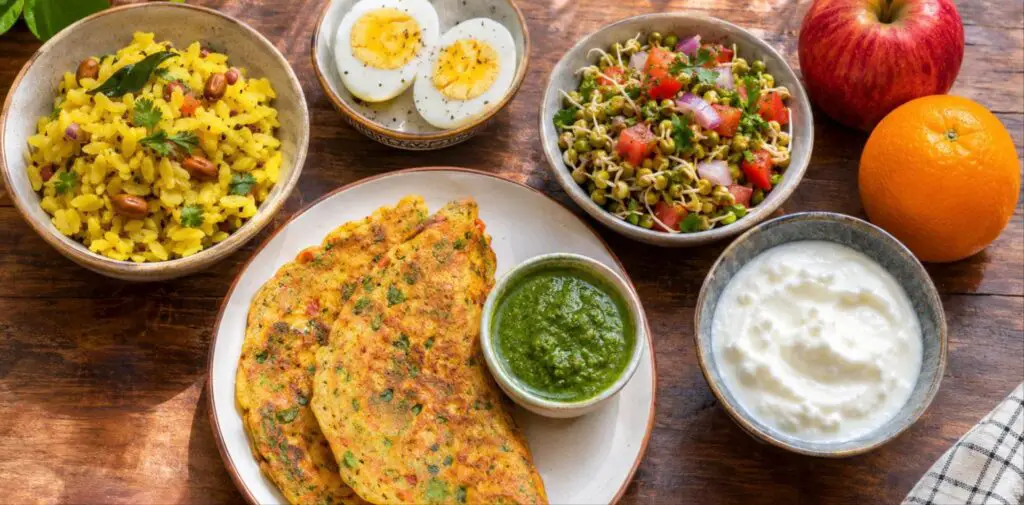
A balanced breakfast has three parts: protein, fibre (vegetables, whole grains, pulses, whole fruit) and some healthy fat. Here are easy desi options:
| Breakfast | Why it works | Tip |
|---|---|---|
| Besan chilla | Chickpea flour is rich in protein and fibre, with a low GI | Add grated vegetables and serve with curd or green chutney |
| Moong dal chilla | High in protein, light to digest | Soak dal overnight; add ginger and jeera |
| Poha with peanuts | Peanuts add protein and fat that slow digestion | Load with vegetables, add lemon, keep the portion moderate |
| Eggs (boiled, omelette, bhurji) | High-quality protein, very filling | Pair with a multigrain roti or vegetables |
| Idli or dosa with sambar | Fermented, and sambar adds dal protein and vegetables | Eat more sambar and fewer idlis |
| Vegetable upma or daliya | Warm and filling; daliya has more fibre than suji | Add vegetables and a handful of peanuts |
| Sprouts chaat | High in protein and fibre | Add onion, tomato, lemon and roasted jeera |
| Curd or Greek yogurt with nuts and seeds | Protein plus healthy fats | Use plain curd and add whole fruit instead of sugar |
| Rolled oats or overnight oats | Better than instant oats; more fibre | Cook in milk, add nuts and seeds, skip extra sugar |
| Paneer or tofu bhurji with roti | High protein for vegetarians | Use little oil and add capsicum or spinach |
Whole fruit, not juice: have an apple, orange, guava, pear or a bowl of papaya. The fibre slows sugar absorption and keeps you full.
If you love cereal: choose a plain, low-sugar, high-fibre cereal such as plain muesli or rolled oats, keep the bowl small, and add protein (milk, curd, nuts, seeds) on the side.
What About Kids?
Many parents give cereal and juice because it is quick and marketed for children. A few practical points:
- Check the sugar. Many kids’ cereals are sweeter than plain cornflakes. Compare the “added sugars” line.
- Add protein. Pair cereal with milk, an egg, curd or a few nuts, or switch some days to a chilla, poha, idli or paneer paratha.
- Whole fruit over juice. Most child-health guidelines advise limiting fruit juice for children and choosing whole fruit instead.
- Make it easy. Batter for chilla or idli can be made the night before; boiled eggs and sprouts keep in the fridge.
- Don’t make breakfast a battle. An occasional bowl of cereal is fine. The aim is a better daily pattern, not perfection.
Who Should Be Most Careful?
A high-sugar, low-protein breakfast is a bigger problem for some people:
- People with diabetes or prediabetes: high-GI breakfasts can push morning sugar higher. Discuss breakfast with your doctor or dietitian, especially if you take insulin or sulfonylureas, which can cause lows if you skip or change meals.
- People with PCOS or insulin resistance: protein- and fibre-rich breakfasts help steady blood sugar.
- People with fatty liver: cutting free sugars, especially from drinks, is part of standard advice.
- People trying to lose weight: protein at breakfast helps control hunger later in the day.
- Children and teenagers: they need protein and steady energy for school.
If you often feel shaky, sweaty, very hungry or faint a few hours after meals, mention it to a doctor. It can be a sign of reactive low blood sugar or another condition worth checking.
Myths vs Facts
| Myth | Fact |
|---|---|
| Cereal is healthy because the box says “fortified” or “whole grain” | Added vitamins don’t change a high GI, low protein or added sugar. Read the nutrition panel |
| 100% fruit juice is as good as fruit | Juice lacks fibre, delivers sugar fast and is linked with higher diabetes risk; whole fruit is linked with lower risk |
| The morning makes sugar more harmful | Glucose tolerance is usually better in the morning. The problem is the type of breakfast, not the clock |
| Cornflakes are the most dangerous breakfast in the world | They are a poor daily choice, but oily, fried breakfasts every day have serious problems too |
| Everyone crashes 2 hours after cereal | The size of spikes and dips varies; many people simply get hungry again quickly |
| A healthy breakfast must be complicated | Besan chilla, poha with peanuts, eggs or sprouts take 10–15 minutes |
| Skipping breakfast is better than a bad breakfast | It depends on the person. For many, a balanced breakfast helps control hunger and snacking later |
Frequently Asked Questions
Is cornflakes a healthy breakfast?
Plain cornflakes are low in fat and fortified, but they have a high glycaemic index and little protein or fibre. As an everyday breakfast, they are a weaker choice than protein- and fibre-rich options.
What is the glycaemic index of cornflakes?
About 81, which is high. White bread is about 75, and rolled oats about 55.
Is packaged fruit juice good for health?
It is better than soft drinks, but it is still free sugar without fibre. Whole fruit is the better choice.
Is fresh home-made juice better than packaged juice?
It has no preservatives or added sugar, but it still lacks fibre and concentrates sugar. Eating the whole fruit is better.
Why do I feel hungry at 11 a.m. after cereal?
Cereal and juice digest quickly and have little protein or fibre, so fullness fades fast. In some people, blood sugar also dips after an early spike.
Can cereal and juice cause diabetes?
No single food causes diabetes. But a regular pattern of refined carbohydrates and sugary drinks, along with weight gain and inactivity, raises the risk.
Is cornflakes with milk okay for people with diabetes?
It can raise blood sugar quickly. People with diabetes are usually better off with a protein- and fibre-rich breakfast and should check with their doctor or dietitian.
Is poha a healthy breakfast?
Yes, in moderate portions with vegetables and peanuts. Poha alone is mostly carbohydrate, so the additions matter.
Is besan chilla good for weight loss?
It is high in protein and fibre and very filling, which can help with weight management when cooked with little oil.
Are oats better than cornflakes?
Rolled or steel-cut oats are better, with more fibre and a lower GI. Instant flavoured oats can be almost as high-GI as cornflakes.
What is a good breakfast for kids instead of cereal?
Eggs, paneer or vegetable paratha with curd, besan or moong chilla, idli-sambar, poha with peanuts, or a smoothie made with whole fruit and curd.
How much protein should breakfast have?
As a general guide, aiming for about 15–25 g of protein at breakfast helps most adults stay full until lunch.
Is muesli healthy?
Plain, unsweetened muesli with nuts and seeds can be a good option. Many packaged mueslis contain added sugar, so check the label.
Are chocolate or honey cereals worse than plain cornflakes?
Usually yes, because they contain much more added sugar.
Can I eat fruit with breakfast?
Yes. Whole fruit with breakfast is a good habit and much better than juice.
Is a samosa or aloo paratha better than cereal?
Not really. Deep-fried and very oily breakfasts are high in calories and unhealthy fats. Choose a balanced, home-cooked option instead.
What does Ayurveda say about breakfast?
Ayurveda recommends a warm, light, freshly cooked breakfast that suits morning agni, and discourages cold, heavy, processed foods.
How can I read a cereal label?
Look at sugars per serving, protein and fibre, and the ingredient list. Choose options with low added sugar, more than 3 g of fibre per serving, and whole grains first in the list.
Is it okay to have cereal occasionally?
Yes. An occasional bowl is fine. The concern is a daily breakfast built only on refined cereal and juice.
What should I drink with breakfast instead of juice?
Water, plain milk, buttermilk with little or no sugar.
Scientific Research
- Muraki I, Imamura F, Manson JE, Hu FB, Willett WC, van Dam RM, Sun Q. Fruit consumption and risk of type 2 diabetes: results from three prospective longitudinal cohort studies. BMJ. 2013;347:f5001. Read the study
- Atkinson FS, Foster-Powell K, Brand-Miller JC. International tables of glycemic index and glycemic load values: 2008. Diabetes Care. 2008;31(12):2281–2283. Read the study
- Leidy HJ, Ortinau LC, Douglas SM, Hoertel HA. Beneficial effects of a higher-protein breakfast on the appetitive, hormonal, and neural signals controlling energy intake regulation in overweight/obese, “breakfast-skipping,” late-adolescent girls. American Journal of Clinical Nutrition. 2013;97(4):677–688. Read the study
- Poggiogalle E, Jamshed H, Peterson CM. Circadian regulation of glucose, lipid, and energy metabolism in humans. Metabolism. 2018;84:11–27. PubMed
- World Health Organization. Guideline: Sugars intake for adults and children. 2015.
- Open Food Facts. Kellogg’s Corn Flakes Original (India) nutrition label. Open Food Facts
Conclusion
Cornflakes with packaged juice is not poison, and it is not the single most dangerous breakfast in the world. But as a daily habit, it is a breakfast built on fast-digesting starch and free sugar, with very little protein or fibre. That combination tends to leave people hungry by mid-morning, and over years, a diet heavy in refined carbohydrates and sugary drinks is linked with insulin resistance, weight gain and fatty liver.
The fix is simple and very Indian: a warm, home-cooked breakfast with protein and fibre, such as besan or moong chilla, poha with peanuts and vegetables, eggs, idli-sambar or sprouts, and a whole fruit instead of juice. Small swaps, made most days, matter far more than any single meal.
Medical Disclaimer
This article is for educational purposes only and is not a substitute for professional medical advice, diagnosis or treatment. If you have diabetes, prediabetes, PCOS, fatty liver or another health condition, or if you take medicines that affect blood sugar, talk to your doctor or a qualified dietitian before changing your diet. Do not stop or change any prescribed medicine on your own.
Medically reviewed by: Dr. Arun Jharwal, BAMS, MD (Ayurveda)